Why Your Players Struggle on Slopes: The Science of Hitting from Sloping Lies
Published February 2026
The "Lab" vs. The Links
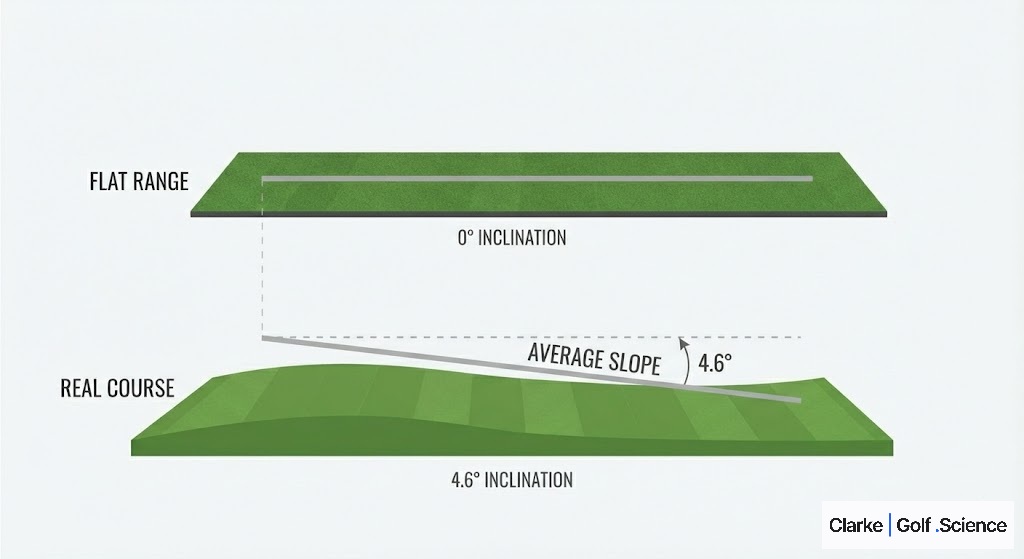
As coaches, we spend the vast majority of our time on level ground - perfectly flat mats and manicured grass ranges. However, the data confirms what we’ve always suspected on the lesson tee: the real game is played on a tilt. Research by Peters, Smith, and Lauder (2015) analyzed nearly 1,000 shots played by professionals across 16 different courses and found that a staggering 80% of shots were played from slopes between 1° and 10°. The average inclination was 4.6°.
But, what does this actually mean for performance? What happens on a sloping Lie? First, we need to answer what we mean by weight and centre of pressure.
What We Really Mean by "Weight Transfer"
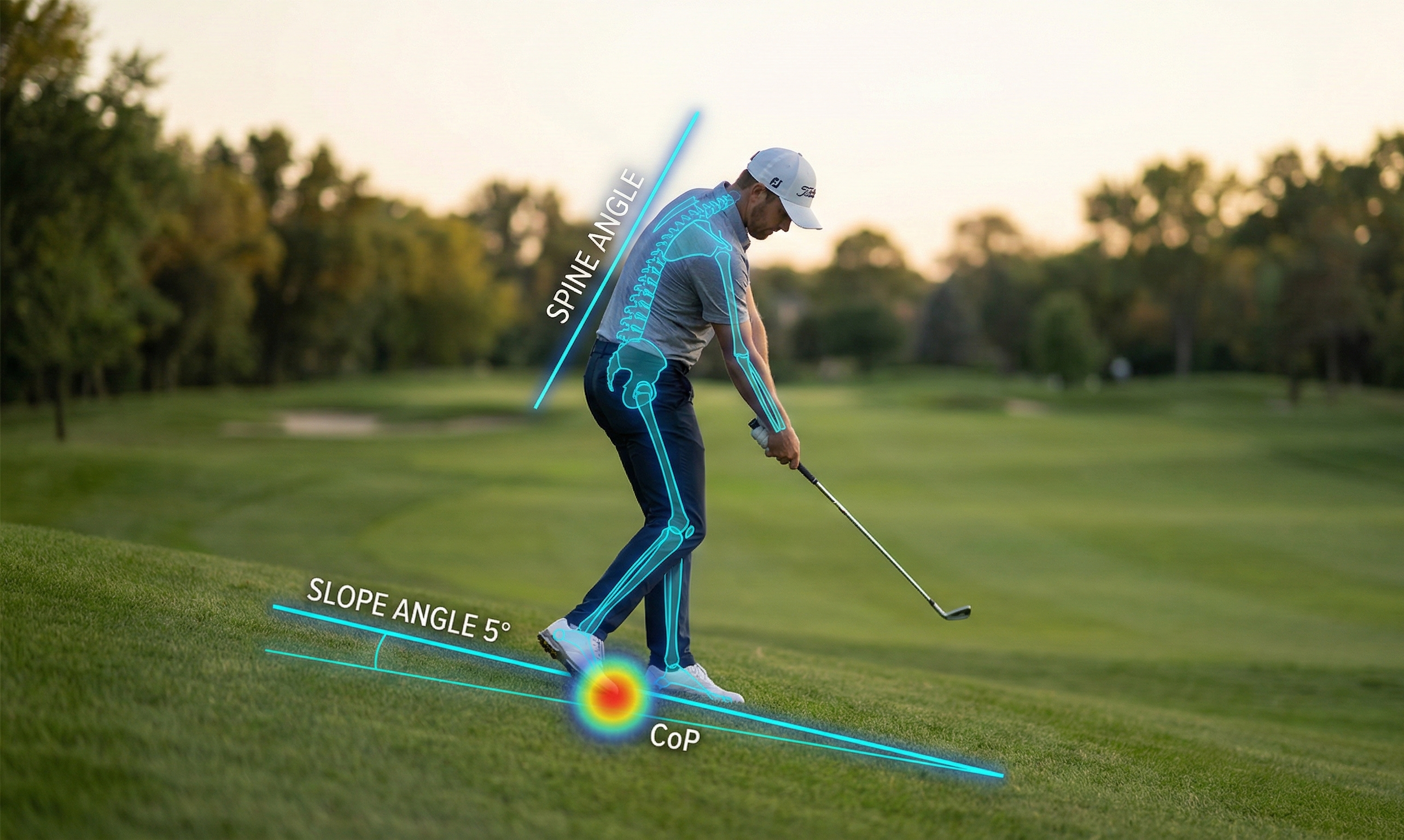
In the coaching world, we often talk about "weight transfer," but from a kinetics perspective, we are actually managing the movement of the Center of Pressure (CoP).
The CoP is the specific point where the ground reaction forces (the "push" from the turf) are concentrated under the feet. To analyse this scientifically, we use a percentage scale relative to the feet:
- 0% CoP: Pressure is entirely on the back foot (trail foot).
- 100% CoP: Pressure is entirely on the front foot (lead foot).
Typically, in a standard flat-ground swing, the CoP moves toward the trail foot during the backswing and transfers rapidly toward the lead foot during the downswing through impact. This does and can change per club condition and task constraint (ie, deep rough, changing trajectory, etc), but that's a story for another day!
The Standard: Replicating "Flat" on a Slope
The "secret" of good ball-striking on uneven ground isn't a special trick; it is the ability to adapt their environment. Low-handicap golfers follow the fundamental advice to set their hips and shoulders perpendicular to the slope, effectively making the slope their "new flat."
According to Blenkinsop et al. (2018), elite players achieve this by shifting their CoP toward the lower foot - roughly a 9% shift - at the start of the swing. Crucially, they maintain this relationship throughout the entire movement. They aren't fighting the slope; they are working with it.
"The low handicap golfers appeared to make a consistent adjustment throughout the swing for the slope... suggesting that they were attempting to recreate the same swing as if on a level surface." Blenkinsop et al. (2018)
The Trap: The "Tilt Gap" and Correction
Whilst better players tend to adapt to the slope, mid and higher handicappers show something different. Mid-high handicap players often set up correctly at address, Hiley et al. (2021) reveals a critical breakdown during the the swing.
The data shows that for mid and higher handicap players, the CoP shift toward the lower foot virtually disappears after the Top of the Backswing (TB). As they transition toward Ball Contact (BC), their brains override the "perpendicular to slope" setup. They seek "verticality" relative to a flat lie, rather than staying perpendicular to the turf.
This "correction toward a flat lie" causes the golfer to lean "into" an uphill slope or lean "back" on a downhill slope during the downswing, compared to better players. On a downhill lie, leaning back can cause bottom of the arc to move behind the ball and creating fat and thin strikes.
Setup Influence: Stability and Width of Stance
While both elite and mid-high handicap groups move the ball position relative to their feet, their methods for achieving stability are vastly different:
- Elite Players: Widely regarded as more stable, they widen their stance to maintain balance and facilitate ball position.
- mid-high handicap players: The Hiley study found that 9 out of 12 mid-handicaps actually narrowed their stance on downhill lies.
This is a "double whammy" for consistency. When you combine a narrow base with the tendency to lean toward gravity during the downswing, a clean strike becomes harder to achieve.
The Ball Flight Reality Check: Launch and Spin
The launch monitor data from these studies provides a much clearer picture on what should happening during uphill and downhill lies:
Uphill Lies
- Launch & Spin: Expect a significant increase in launch angle and lateral spin. For right-handers, uphill lies generate significant left/hook spin (-387 rpm compared to -104 rpm on flat ground).
- Distance: On a 5-degree slope, there is no significant difference in total distance (carry plus roll). The higher launch angle is often offset by other factors, meaning that "clubbing up" may result in overshooting the green.
Downhill Lies
- Launch & Spin: The launch angle decreases significantly and introduces rightward/slice spin (146 rpm).
- Distance: Despite the lower trajectory, total distances remain comparable to flat-ground shots.
Summary: Coaching the "Whole Swing" Adjustment
The research around centre of pressure and sloping lies proves that successful slope play is a dynamic challenge, not just a static one. It is not enough to help a student find a perpendicular setup at address; you must train them to maintain that relationship through the swing.
The next time you see a student struggle on the course, look past the address position. Are they maintaining that 9% shift toward the lower foot through BC, or is their brain pulling them back toward verticality?
References
Blenkinsop, G.M., Liang, Y., Gallimore, N.J. and Hiley, M.J. (2018) 'The Effect of Uphill and Downhill Slopes on Weight Transfer, Alignment, and Shot Outcome in Golf', Journal of Applied Biomechanics, 34, pp. 361-368. Available at: https://doi.org/10.1123/jab.2017-0310
Hiley, M.J., Bajwa, Z., Liang, Y. and Blenkinsop, G.M. (2021) 'The effect of uphill and downhill slopes on centre of pressure movement, alignment and shot outcome in mid-handicap golfers', Sports Biomechanics, 20(7), pp. 781-797. Available at: https://doi.org/10.1080/14763141.2019.1601250